Category: Articles

  • Letter from Margot Kushel

    Letter from Margot Kushel

    December 2, 2015

    Dear Kathleen, Sarah and Lynn,

    Please forgive my delay in writing. You have all been very much on my mind these last few weeks, as has of course, Dick. I hope that during these difficult days and weeks you have been surrounded by love and by all the amazing memories of Dick’s love for you, and for life.

    On Tuesday morning weeks ago, which turned out to be the morning of the day Dick died, I was sitting in the clinic with one of my dearest patients, a patient who Dick had handed down to me when he left the clinic. The patient was pure Dick – an older African American man with a forty year history of being in prison and enough anger at the world to rock one’s faith in it. Dick told me a small amount about his medical history and then said: “He’s a great guy, you’ll love him,” when he passed him on to me. The first day I met him, he was screaming at everyone, including me. In retrospect, he was furious at losing Dick – one of the few people who had believed in him. I remember sitting through the patient’s tirade that day, steeling myself by repeating Dick’s words like a mantra: “He’s a great guy, you’ll love him.” Over time, as I built this gentleman’s trust, I realized that Dick was (of course, as he usually was) absolutely right.

    The patient, with Dick’s help, had rebuilt his shattered life. With treatment for his substance use and his grief, he had met and married a wonderful woman who could see him for what he was and had devoted his life to counseling and advocating for young African American men in trouble with the law. Even though (or maybe because) this patient still erupts in anger at the slightest perceived slight, I have grown to admire him and look forward to our visits. That Tuesday morning, we had a regular visit, where the man was dealing with having been part of a traumatic accident that led to an interaction with the police. I was asking him about that, trying to comfort him and empathize with all the many ways in which that must have been hard. At the end of the visit, the patient sees on our desk, a flyer that says “Richard H. Fine People’s Clinic” and he looks at me and says “Is that Dick Fine?” Our visit was over, and I had two patients waiting, but I sat back down and listened as he asked after Dick and then launched into a story of how Dick was the first person to really believe in him and how meeting Dick was one of the most important things to ever happen to him. We sat together in the clinic for a long while discussing Dick, sharing stories of how wonderful he was and what he had taught us and meant to us.

    I had wanted to write to Dick (the patient asked me to send his love) but later that night or the next morning, before I had written, I heard that Dick had died.

    I wish that you could have been there, because this patient so eloquently expressed so much of what we have all been feeling

    Dick taught me, and so many of us, to see the beauty in the most unlikely people. He taught us to recognize both suffering and oppression and to always strive to be on the right side of it, no matter how the rest of the world saw it or thought of you for doing so. He taught us that gentleness sometimes lies buried in rough exteriors and to always look beyond the exteriors. He taught us to sit with suffering but to fight actively and loudly against oppression.

    Dick was one of my most important teachers and I was blessed to have him as a friend. He was always leaving books, articles and other such things for me, with his trademark Post-its, for things he thought may be of interest. (They always were!)

    Thank you for sharing Dick with all of us – his patients, his students, his colleagues, over the years. His influence on all of us was profound. We all miss him very much, but know that he will live on in all of us who he influenced so profoundly.

    May all your memories be a comfort to you, and may we all lead lives with as much meaning and joy as did Dick.

    With love,
    Margo
  • Dick’s Bibliography

    Dick’s Bibliography

    Dick was interviewed for a number of books about the role of physicians in the political movements of the 1960’s, 70’s and up to the present. Some of his speeches may be found on the web site of the Freedom Archives. Links are listed below.

    His clinic at SFGH, which he founded in 1972 and where he was Medical Director for 25 years, was renamed in his honor in 2015 as the Richard H. Fine People’s Clinic.

    Audio

    Dr. Dick Fine, Medical Committee for Human Rights (MCHR) reads a statement from SF Mayor to Dr. Shapiro of MCHR rejecting demands for immunity for medics at SFSU demonstrations in 1969

    Dr. Dick Fine Moderating discussion of injuries to students and medics

    Dr. Dick Fine describing medical teams, an agreement reached in 1968 on the medical neutrality of teams and access to anyone injured in a public demonstration for Medical Committee for Human Rights (MCHR), but not being honored by SF cops. 1969

    Dick Fine speaks at the United Front Against Fascism conference about the Medical Committee for Human Rights (MCHR) and the need to provide the movement with medical care particularly when in conflict with the police. Dick Fine and Shari Whitehead talk with Elsa Knight Thompson about their trip to New Mexico where they investigated appalling medical conditions and their work with local organizers to create community-based medical resources. (7/20/1969)

    News Articles

    San Francisco Business Times article

    San Francisco Chronicle obituary

    Point Reyes Light obituary

    Richard H. Fine People’s Clinic announcement

    Books

    Books where Dick Fine MD was an author, a subject or was interviewed:

    Altamont: The Rolling Stones, the Hell’s Angels and the Inside Story of Rock’s Darkest Day – Joel Selvin, 2016, Dey Street, an imprint of William Morrow Publishers (pages 143-44, 146, 169, 219-20, 249)

    The Good Doctors: The Medical Committee for Human Rights and the Struggle for Social Justice in Health Care – John Dittmer, 2009, Bloomsbury Press (pages 200-201)

    Indian Self-Determination and the Rise of Indian Activism: The Occupation of Alcatraz Island – Troy R. Johnson, 1996, University of Illinois Press (page 89)

    Beat the Heat: A Radical Survival Handbook, First Aid for Activists – Ramparts Press, 1972, (illustration at p. 207 is Dick Fine)

    Medical Cadre, booklet prepared by MCHR for Conference on United Front Against Fascism – published by Jellyroll Press, Oakland, 1969. (Photo at page 9 is Dick Fine at SF State Strike)

    Only Human is the title of an unpublished book Kathleen Campbell wrote about Dick. Specifically his accounts of his day to day life at San Francisco General Hospital.

    Dick often quoted Dylan Thomas: “‘I’m only human’, cries the man, who deep in his heart refuses to believe it.”

    The full quote by Dylan Thomas is:

    “I am the kind of human dredger that digs up the wordy mud of his own dead sea; the kind of pig who roots for unconsidered truffles in the reeky wood of his past. Still I gladly accept the fact that I first saw the light and screamed at it in a loud lump of Wales. ‘I’m only human’ as the man says who deep inside him refuses to believe it.”

    Thank you to determined blogger Jason Kirin for finding and publishing the transcript of this talk.

    A recording of Dylan Thomas himself giving the reading “A Few Words of a Kind” at the Massachusetts Institute of Technology, where the Only Human quote appears is available here, which gives the date as 1957. However, it is unclear what this date signifies, since the poet died in 1953. A vinyl recording of “A Few Words of a Kind” and an mp3 file are also available on Amazon, entitled Dylan Thomas Reads His Complete Poems.

  • Early Activism

    Early Activism

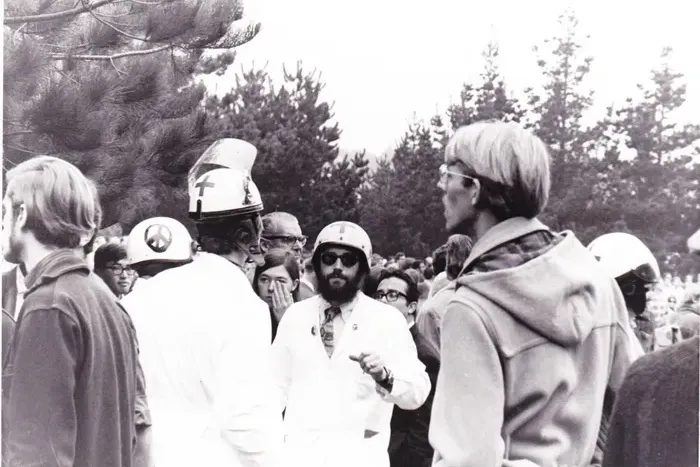
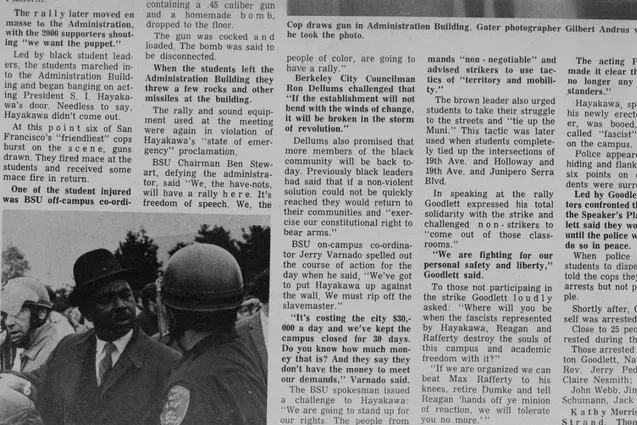
    Dick almost didn’t finish his training at UCSF. The Chair of the UCSF Department of Medicine in the late 1960’s, Lloyd Hollingsworth “Holly” Smith, kicked him out of his residency for his political activities – while a resident he had taken charge of the medical care for the students who were on strike for months at San Francisco State College, who were routinely tear gassed and beaten by the San Francisco Police. Dick recruited fellow doctors like his friend Morrie Schambelan, as well as SFGH nurses, to take care of the injured students and Holly disapproved of mingling medicine and politics. To Dick his conscience wouldn’t let him stand by and let such massive injustice happen.

    Another high-ranking faculty doctor, Elliot Rappaport, a well-respected cardiologist, advised Holly that this idealistic young doctor was exactly the kind of physician that San Francisco General needed, and Holly reluctantly reinstated him.

    In 2008, John Dittmer interviewed Dick for the book, The Good Doctors: The Medical Committee for Human Rights and the Struggle for Social Justice in Health Care. Dick passed along his knowledge of the MCHR role in the Bay Area.

    In 1966, as Dick was beginning his internship, he had been persuaded by psychiatrist Dr. Phil Shapiro to work with the San Francisco Bay Area chapter of the Medical Committee for Human Rights.

    In fall 1968, when violence broke out at San Francisco State University after students went on strike, Fine was in charge of the medical presence on campus. “Every day at twelve o’clock we would come to San Francisco State for the riot,” he recalled. A good friend, professional photographer Ed Holcomb, risked injury to himself and his cameras to photograph the strike, focusing on the volunteer doctors and nurses, who were themselves targeted for violence by the police. The unique images are in the University Archives, Dr. Richard H. Fine SF State Strike Medical Committee for Human Rights Photograph Collection in the Library at San Francisco State University.

    In early 1969, after the SF State Strike ended, he traveled to Tierra Amarilla, New Mexico, where he worked with a group including the Tijerina brothers, Maria Varela and other local organizers, who were establishing a locally created and controlled health center, ultimately named La Clinica del Pueblo de Rio Arriba, which celebrated its 50th anniversary in 2019.

    On November 20, 1969, a group of American Indians occupied the abandoned federal prison on Alcatraz Island in San Francisco Bay, which they held for 18 months. Dick Fine made a weekly trip to bring medical supplies to the island on the “official” ferryboat and remained to treat patients for minor injuries, colds and pneumonia.

    In 1970, Dick helped establish the Black Man’s Free Clinic with Dr. Bert Small and the Black Panther Party in Oakland, and recruited physicians and nurses from San Francisco General Hospital to volunteer there.